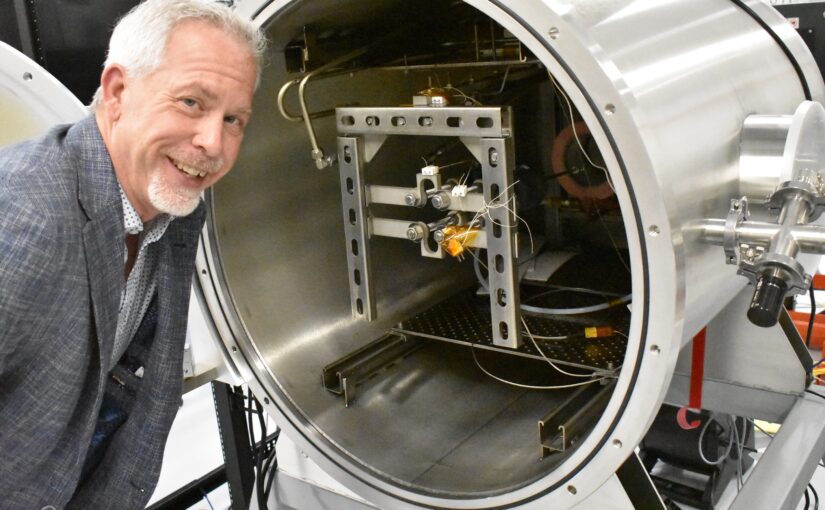
Uncommon Thinkers: How Portal’s Jeff Thornburg plans to harness the heat of the sun in the cold of space

Editor’s note: This series profiles six of the Seattle region’s “Uncommon Thinkers”: inventors, scientists, technologists and entrepreneurs transforming industries and driving positive change in the world. They will be recognized Dec. 11 at the GeekWire Gala. Uncommon Thinkers is presented in partnership with Greater Seattle Partners.

BOTHELL, Wash. — Before he became the CEO of Portal Space Systems, Jeff Thornburg worked for two of the world’s most innovative space-minded billionaires. Now he’s working on an idea those billionaires never thought to pursue: building a spacecraft powered by the heat of focused sunlight.

Thornburg and his teammates are aiming to make Bothell-based Portal the first commercial venture to capitalize on solar thermal propulsion, a technology studied decades ago by NASA and the U.S. Air Force. The concept involves sending a propellant through a heat exchanger, where the heat gathered up from sunlight causes it to expand and produce thrust, like steam whistling out of a teakettle.

The technology is more fuel-efficient than traditional chemical propulsion — and faster-acting than solar electric propulsion, which uses solar arrays to turn sunlight into electricity to power an ion drive. Solar thermal propulsion nicely fills a niche between those two methods to move a spacecraft between orbits. But neither NASA nor the Air Force followed up on the concept.“They didn’t abandon it for technical reasons,” Thornburg said. At the time, it just didn’t make economic or strategic sense to take the concept any further.

What’s changed?“Lower launch costs, coupled with additive manufacturing, are the major unlocks to bring the tech to life, and make it affordable and in line with commercial development,” Thornburg said.

Thornburg argues that it’s the right time for Portal’s spacecraft to fill a gap in America’s national security posture on the high frontier. “There was no imperative for rapid movement on orbit in the 1990s,” he said. “Only recently have the threats from our adversaries highlighted the weaknesses in current electric propulsion systems, in that they have so little thrust and can’t enable rapid mobility.”

Portal’s vision has attracted interest — and financial support — from investors and potential customers. Since its founding in 2021, the startup has raised more than $20 million in venture capital. In 2024, Portal won a commitment for $45 million in public-private funding from SpaceWERX, the innovation arm of the U.S. Space Force. And next year, Portal is due to demonstrate its hardware for the first time in orbit.

So, how did Thornburg hit upon the idea of turning a decades-old idea into reality? Thornburg, who’s now 52 years old, has focused on making things fly for most of his career. It all started when he was a college student in Missouri in the early 1990s, earning his aerospace engineering degree with an ROTC scholarship from the Air Force. He recalled a conversation he had with an instructor who was an old F-4 fighter pilot.“With my nearsightedness, I was out of the game from a pilot standpoint,” Thornburg said. “But he said, ‘Thornburg, if you can’t fly the planes, go be as close to them as you can.’”

Thornburg signed up for a program that fast-tracked him into an aircraft maintenance role. He traveled around the world with KC-135 cargo planes, supporting missions that included the NATO-led air campaign against Yugoslavia in 1999. During his time as a flight commander and aircraft maintenance officer at MacDill Air Force Base in Florida, “I had a couple of hundred enlisted people who worked hard to keep me out of trouble,” he said. The Air Force is where he earned his master’s degree in aerospace engineering. “My adviser had a friend that worked at the Air Force Research Lab,” Thornburg recalled. “He called him and said, ‘The Air Force is about to send this guy to do something with airplanes, but I’m pretty sure he’s going to be disappointed if he can’t come out and work on rocket engines.’”

Sure enough, Thornburg was soon working on rocket propulsion development, including a project to create what’s known as a full-flow staged combustion cycle engine. “We made what people thought was not possible possible with that program,” Thornburg said.

In 2004, Thornburg left the Air Force to work on rocket propulsion systems at Exquadrum, Aerojet and NASA. Then, in 2011, he took a phone call from SpaceX’s billionaire founder, Elon Musk. “We talked for about an hour, hour and a half on the phone — and he said, ‘I’ve got a project I want to talk to you about,’” Thornburg said. That project led to the development of SpaceX’s methane-fueled Raptor rocket engine, which leveraged the technology that Thornburg helped pioneer at the Air Force. “That was a wild ride, because that felt like about 15 or 20 years of experience in a five-year time period,” he recalled.

After five years at SpaceX, Thornburg needed to wind down. He decided to do some consulting at his home base in Huntsville, Alabama, also known as Rocket City. “About six months in, I’m like, I need a real job again,” he said. “And some friends of mine introduced me to, ultimately, Paul Allen. Paul called me and said, ‘Can you come out to my Seattle office?’” The Microsoft co-founder and software billionaire enlisted Thornburg to become the head of rocket propulsion development for Stratolaunch, Allen’s space venture. Thornburg led the effort to create a liquid rocket engine known as the PGA — which stood for “Paul G. Allen.” Unfortunately, Allen passed away in 2018, just one month after the engine was unveiled. Under new ownership, Stratolaunch pivoted to hypersonic testing, and the PGA project fell by the wayside. Once again, Thornburg and his family hunkered down in Huntsville.“I decided to start my first space company after Paul died,” Thornburg said. “I focused on hydrogen propulsion technology and solutions, kind of like what we were working on for Paul.”

That first company, Interstellar Technologies, started working on projects for NASA, Northrop Grumman and a couple of other customers. Then the pandemic hit. “The investors that were about to provide funding disappeared,” Thornburg said. “NASA went home, Northrop Grumman went home. And so I had to find my small team other jobs.” Just as Thornburg was about to resign himself to riding out the pandemic in Alabama, Amazon’s recruiters called. They asked him to move to Seattle to run engineering and manufacturing for Project Kuiper, the satellite internet project that’s now known as Amazon Leo. “That’s ultimately what got us moved to Seattle,” Thornburg said. His yearlong stint at Amazon was long enough to establish the process for building Project Kuiper’s two prototypes and the production-grade satellites that came after them. Then he took on engineering management roles at Agility Robotics and Commonwealth Fusion Systems.

That’s when Portal Space Systems took shape.

To be fair, the seeds for Portal were planted back in 2016, just weeks after Thornburg left SpaceX. “Lawrence Livermore Lab had called and said, ‘We’re doing a seminar on the future of propulsion. Would you like to come be a speaker?’” he recalled. “I said, ‘Yes, what do you want me to talk about?’ They said, ‘We want you to tell us what the future of propulsion looks like.’ Oh my gosh, no pressure on that!”

As he did the research for his talk, he came across the idea of putting a nuclear reactor on a spacecraft, and using the concentrated heat from that reactor to blast a propellant through a thruster. The concept, known as nuclear thermal propulsion, seemed like a stretch — but then Thornburg had an uncommon thought.“Can you concentrate solar energy to heat a thrust chamber and do the same thing?” Thornburg said. “You can. It’s not quite as effective as a nuclear reactor, for obvious reasons, but it’s all the same pieces. … Now I don’t have to wait on a low-cost, low-weight, space-rated nuclear reactor that doesn’t exist yet.”

Thornburg mulled over the idea for years. “I was thinking about Portal, and I was starting the beginnings of Portal in 2021, but I still had to pay the bills,” he said. For a couple of years, he worked during the day at Agility Robotics and Commonwealth Fusion — and spent nights and weekends laying the groundwork for the startup.“When Portal could really start to stand on its own, as we started to win over the Defense Department, that’s when I made the switch with all of my time focused on what was going on in Portal,” Thornburg said. In April 2024, the startup emerged from stealth and announced it had received more than $3 million in funding from the Defense Department and the Space Force. Portal’s flagship vehicle is called Supernova. It’s a rapid-transorbital, multi-mission vehicle that should be capable of moving itself and its payloads from one orbit to another — even from low Earth orbit to geostationary Earth orbit, more than 20,000 miles higher up. And it should be able to do that within hours or a day, rather than the weeks or months that are typically required. The spacecraft itself will be about the size of a restaurant refrigerator. To concentrate sunlight on its heat exchanger and thruster system, Supernova will use sheets of reflective material that can unfold to a width of roughly 55 feet. Ammonia will serve as the propellant. The 3D-printed heat exchanger thruster, dubbed Flare, was successfully tested earlier this year.

Next year’s orbital demonstration will involve putting an instrument package known as Mini-Nova, which is about the size of a tissue box, on a satellite platform that’s due for launch on a SpaceX rideshare mission. The demonstration is meant to validate Supernova’s system design. In late 2026, Portal plans to send up a free-flying spacecraft called Starburst, which will be equipped with thrusters powered by an electrothermal heating system. Starburst won’t be as powerful as Supernova, but it will provide Portal’s customers with an early option for rapid maneuverability in orbit. If next year’s test goes well, Starburst is expected to start taking on customer missions in 2027. 2027 is also the year when Supernova is scheduled to make its debut. All of the development work for Supernova and Starburst will be taking place at Portal’s 8,000-square-foot lab and 50,000-square-foot manufacturing facility in Bothell. Throughout Portal’s formative years, Thornburg has worked with fellow members of the “small team” he assembled at Interstellar Technologies. Both of Portal’s other co-founders — chief operating officer Ian Vorbach and engineering vice president Prashaanth Ravindran — crossed paths with Thornburg at Interstellar, and at Stratolaunch before that. Vorbach, whose background includes startup experience as well as engineering experience, said Portal’s business model has been fine-tuned to make sure it addresses the needs of its target market. He and Thornburg identified the U.S. military’s need for tactical responsiveness in space as the top priority.“What happens a lot in the space industry is that you have incredibly technical, talented people who have a technology that provides some very unique performance, and then they build it, and it turns out that performance isn’t needed,” Vorbach said. “There’s got to be a reason to bring that innovation to market.”

Vorbach is grateful for Thornburg’s leadership. “We work very long hours, but I think Jeff does a great job of making sure people know that they’re valued,” he said. “I appreciate that, and I think it’s why we, fortunately, are able to hire great talent from the places he’s come from, whether it’s SpaceX or Kuiper.” Ravindran, who worked at Jeff Bezos’ Blue Origin space venture before taking a founder’s role at Portal, agreed with that assessment. “It’s always amazing to have someone like Jeff out there, because he’s come up the engineering road to realize our pain points as well, and he doesn’t try to hold us to unfair standards.” Stan Shull, a space industry analyst at Bellevue, Wash.-based Alliance Velocity, gives Portal high marks. “In space terms, a highly maneuverable satellite is said to have high delta-V,” he told GeekWire in an email. “Portal, as a company, feels high delta-V too.”

Залучення інвестицій у стартапі: Ключові поради в епоху штучного інтелекту

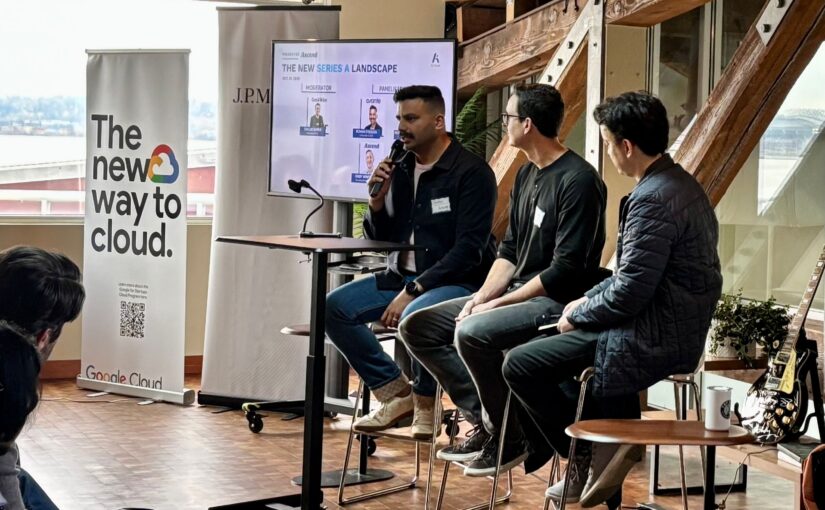
Якщо ви будуєте ранній стартап і намагаєтеся залучити інвестиції венчурного капіталу, щоб реалізувати свої великі ідеї – зосередьтеся на вирішенні конкретної проблеми, переконайтеся, що у вас сильна переконаність, і глибоко подумайте про дистрибуцію в епоху штучного інтелекту. Ці поради були поділені під час нещодавньої панельної дискусії Seattle AI Week, яку я модерував з Келланом Картером, засновуючим партнером Fuse, та Роханом Д’Соузою, генеральним директором і співзасновником Avante, стартапу з послуг з охорони здоров’я.

Пара добре знайома один з одним. Fuse взяла участь у раунді seed-фінансування Avante на 10 мільйонів доларів у пізній 2023 році, перш ніж компанія почала генерувати значний дохід. Келан Картер спочатку познайомився з Роханом Д’Соузою кілька років раніше. “Тут було так багато довіри”, – сказав Келан, віддзеркалюючи важливість побудови відносин між засновниками та інвесторами.

Назва панельної дискусії, організованої Seattle VC firm Ascend, була “The New Series A Landscape” – вказівка на зміну очікувань в епоху AI. Середній розмір раунду Series A в першій чверті цього року становив 7,9 мільйонів доларів, згідно з даними Carta. Але були й дев’ять компаній, які за підрахунками CB Insights, за підрахунками CB Insights, підняли понад 200 мільйонів доларів на своїх раундах Series A в третьому кварталі. “Варіативність для Series A зараз більше, ніж будь-коли,” – сказав Келан.

Для тих компаній, які залучають величезні раунди Series A, Келан сказав, що це про “нечесний інсайт”, який створює переконаність і відкриває двері до капіталу. “Інсайт такий очевидний, що це захоплює інвесторів і змушує їх погодитися на таку велику суму – тому що нагорода зараз така велика,” – сказав Келан.

Фінансування стартапів збільшилося до максимуму за три роки, переважно завдяки штучному інтелекту, який забезпечив 51% усього фінансування та 22% угод у третьому кварталі, згідно з даними CB Insights. Келан пожартував, що AI тепер завжди є в пітчі – навіть якщо це не AI. Для Fuse оцінка пітчу полягає у визначенні найкращого способу вирішити проблему клієнта – з чи без AI. Келан сказав, що інвестори схильні віддавати перевагу засновникам, які мають досвід у галузі та краще розуміють першочергову проблему клієнта. “У них є знання, які дають їм легітимність у розмові з клієнтом,” – сказав він.

І в світі, де AI змінює спосіб продажу програмного забезпечення, Келан сказав, що він шукає чіткої переваги дистрибуції. “Продукт не переможе”, – сказав він. “Дистрибуція переможе.” Він додав: “Ми любимо засновників, які мають досвід у галузі, які мають знання, і вони можуть змусити нас захоплено говорити про стратегію дистрибуції, яка є трохи більш вигадковою чи унікальною в епоху AI.”

Коли йдеться про обговорення AI під час пітчу, розмова буде відрізнятися залежно від того, чи ви розмовляєте з клієнтом, чи з інвестором, згідно з Роханом. Він сказав, що клієнти можуть мати “FOMO” (страх пропустити) у зв’язку з AI, але, швидше за все, вони насправді мають “FOMU” (страх зробити помилку). Рохан сказав, що це завдання засновника – допомогти клієнтам зрозуміти, що це про “відкриття нового способу продуктивності”.

Для інвесторів Рохан сказав, що важливо показати, як AI покращує рентабельність, наприклад, прискорює залучення та онбординг клієнтів. Avante офіційно запустилася цього року, масштабуючи свій програмний продукт, який має допомогти компаніям зменшити навантаження на адміністративні функції з управління персоналом і знизити загальні витрати на програмні продукти.

Коли він думає про залучення раунду Series A фінансування, Д’Соуза сказав, що одна перевага – отримати свіжу готівку – це сигнал для покупців, якій можуть бути обережні на ранній стадії, 20-осіб, заснованої в Тихоокеанському регіоні. “Тут є трохи такого сприйняття, що, що станеться, якщо ці хлопці підуть? Він сказав: “Отже, як засновник, я кажу: ОК, чи дійсно нам варто почати жорстко домагатися в більшму грошей на балансі? Щоб надіслати чітке повідомлення про те, що у нас є ще багато газу в баку, навіть якщо нам не надто потрібно.”

Щодо конкурентів, Д’Соуза сказав, що засновникам слід зосереджуватися не на схожих стартапах, а на магістральних. “Чим вони відкривають функціональні можливості? І як ви можете зробити це набагато швидше?” – сказав Келан. Келан відзначив, що Fuse залишається осторонь компаній, які можуть безпосередньо конкурувати з Microsoft, Amazon, OpenAI або Anthropic. “Якщо ми думаємо, що є натяк на те, що вони випустять продукт, і наступним кроком є конкуренція з безкоштовним або з’єднанням – це проблема,” – сказав Келан.

Рохан, колишній головний продуктний менеджер в компанії з автоматизації охорони здоров’я Olive AI, наголосив на важливості прозорості з боку інвесторів. “Будьте дуже чіткими щодо ваших часових рамок”, – сказав він. “Якщо вам потрібно три або шість місяців, щоб побудувати ядро вашого продукту, будьте дуже прозорими щодо цього.”

Д’Соуза сказав, що Avante навмисно не планував повторюваної оплати до 2024 року, запустив програму для ранніх користувачів, яка не була безкоштовною, а потім вийшов із приховування в квітні 2025 року та перетворив пілоти на багаторічні угоди. “Ми створили трохи дефіциту та FOMO навколо цієї концепції програми для ранніх користувачів,” – сказав він.

Д’Соуза також порадив своїм колегам-засновникам зосередитися на “основній справі, яку ви робите на 100x краще.”

Sam Ransbotham on Navigating the Nuances of AI: Beyond Hype and Mediocrity

Sam Ransbotham, a professor of business analytics at Boston College and host of the ‘Me, Myself and AI’ podcast, offers a pragmatic perspective on the evolving role of Artificial Intelligence. He observes a fascinating trend in his classroom: while some students are leveraging AI to achieve remarkable results, others fall into the trap of ‘phoning things into the machine,’ leading to a superficial engagement with the technology. Ransbotham emphasizes that the depth of understanding a user possesses directly correlates with the value derived from a tool. A cursory approach yields a rudimentary outcome, while deeper exploration unlocks greater potential.

Despite concerns about students prioritizing mediocrity—highlighting Boston College’s ‘Ever to Excel’ motto—Ransbotham maintains a positive outlook on AI’s potential. He argues that the technology’s true value often lies not in its output, but in the critical thinking it inspires. ‘The data gives better insights about what you’re doing, about the documents you have, and you can make a slightly better decision,’ he states, emphasizing the importance of questioning AI’s outputs, even when they seem ‘wrong’ or ‘ridiculous.’

Ransbotham draws parallels between the rise of Wikipedia and the current AI landscape. Just as Encyclopedia Britannica’s economic value diminished with the advent of Wikipedia, AI’s value extends beyond immediate, quantifiable results. He focuses on the ability of AI to provide new insights and encourage deeper analysis, framing the technology as a tool for ‘searching for the signal in the noise.’ Ultimately, Ransbotham advocates for a thoughtful and discerning approach to AI, recognizing its potential while guarding against the temptation of simply accepting superficial outcomes.

Verizon Зменшує Штат в А Washington штаті: 168 працівників звільнені

Verizon оголошує про звільнення приблизно 168 співробітників у штаті Вашингтон, включаючи аналітиків, інженерів та працівників роздрібної торгівлі. Інформація про звільнення була розголошена у повідомленні Worker Adjustment and Retraining Notification (WARN), яке було подано до відділу зайнятості штату. Звільнення заплановано на 23 січня.

«Verizon консолідує та реструктуризує свою діяльність, щоб максимізувати використання об’єктів та ресурсів компанії», – зазначила Ебоні Грегоре, директорка з операцій HR Verizon, у листі WARN. Раніше цього місяця The Wall Street Journal повідомила, що New York-based Verizon планує скоротити 15 000 працівників, переважно через звільнення. Це включає перехід близько 200 магазинів у франчайзингові мережі, що виключає працівників із штату Verizon.

У листі WARN зазначено, що п’ять об’єктів – у Redmond, Renton, Woodinville, Spokane та Bellingham – «передаються агенту» та більше не будуть експлуатуватися Verizon. Не було зрозуміло, закриються об’єкти або стануть франшизою.

Приблизно 22 з працівників, яких звільняють, базуються в корпоративному офісі у Bellevue, штат Washington, який Verizon отримала від конкурента T-Mobile рік тому. T-Mobile, штаб-квартира якого розташована у Bellevue, здає в оренду 32 682 квадратних футів простору у будівлі 90 North за адресою 3255 160th Ave. SE., як повідомляє Puget Sound Business Journal. Це було раніше повідомлено.

Звільнення відбувається на тлі втрати Verizon 7 000 підписників у останньому кварталі, тоді як AT&T та T-Mobile додають клієнтів, як повідомляє WSJ. У четвер T-Mobile оголосила про ініціативу «Switching Made Easy», яка стартує наступного місяця, щоб допомогти клієнтам Verizon та AT&T переходити на T-Mobile протягом 15 хвилин.

Rad Power Bikes Faces Another Roadblock as CPSC Issues Battery Warning

Embattled electric bike maker Rad Power Bikes is facing another challenge as the U.S. Consumer Product Safety Commission (CPSC) issued a warning to consumers Monday to stop using some of the Seattle-based company’s bikes because of danger posed by their lithium-ion batteries.

The product safety warning urges consumers to immediately remove and dispose of hazardous batteries that “can unexpectedly ignite and explode, posing a fire hazard to consumers, especially when the battery or the harness has been exposed to water and debris.”

The CPSC said Rad “has refused to agree to an acceptable recall” for the batteries, which are manufactured in China.

The batteries were sold as replacements and with a variety of Rad bikes via Rad’s website, Best Buy stores and independent bike shops. The battery model number (HL-RP-S1304 or RP-1304) is printed on a label on the back or rear of the battery and bike models included: RadWagon 4, RadCity HS 4, RadRover High Step 5, RadCity Step Thru 3, RadRover Step Thru 1, RadRunner 2, RadRunner 1, RadRunner Plus, and RadExpand 5. The report adds another significant obstacle to Rad’s continued operations.

Earlier this month, Rad revealed that it was struggling to survive due to financial difficulties, and the e-bike seller said that it was in danger of shutting down by early January.

On Monday, Rad disputed the CPSC’s findings. “Rad Power Bikes firmly stands behind our batteries and our reputation as leaders in the e-bike industry, and strongly disagrees with the CPSC’s characterization of certain Rad batteries as defective or unsafe,” the company said in a lengthy statement provided to GeekWire (in full below).

Rad said the significant cost of CPSC’s all-or-nothing recall demand would force Rad to shut down immediately with no way to support its riders or employees.

CPSC Warns Consumers to Immediately Stop Using Batteries for E-Bikes from Rad Power Bikes Due to Fire Hazard; Risk of Serious Injury or Death www.cpsc.gov/Warnings/202…

Rad said it offered “multiple good-faith solutions” to address CPSC’s concerns over at least 31 reports of fire, including what the agency said were 12 reports of property damage caused by Rad batteries, totaling approximately $734,500.

Rad said the incident rate associated with the batteries in the CPSC’s notice is a fraction of one percent.“While that number is low, we know even one incident is one too many, and we are heartbroken by any report involving our products,” the company’s statement read.

The company said its batteries were tested by independent third-party labs as part of its typical product testing and again during the CPSC investigation, “and confirmed compliance with the highest industry standards.”

Rad upgraded its bikes to what it calls the Rad Safe Shield battery in early 2024, and the company said it offered to upgrade consumers to those batteries at a substantial discount as part of one of its solutions during the CPSC investigation.

The company stressed in its statement that all lithium-ion batteries, not just in e-bikes, can pose a fire risk if improperly handled or exposed to significant water, and the company promotes proper care and maintenance in its user manuals and customer safety guides.

Rad Power Bikes, headquartered in Seattle’s Ballard neighborhood, launched as a direct-to-consumer brand in 2015. The company saw huge demand amid the pandemic as more people bought e-bikes. Its sales and workforce surged and it raised more than $300 million from investors in 2021. The company was valued at $1.65 billion that year, according to PitchBook, making it one of a handful of “unicorn” startups in the Seattle region at the time.

The company has attracted nearly 700,000 riders around the globe, but a series of missteps and macroeconomic challenges in recent years have led to more than seven rounds of layoffs and a remarkable downfall.

Three years ago, Rad issued a recall on its RadWagon 4 electric cargo bikes over an issue with tires and rim strips that created a fall and crash hazard.

In 2023, The New York Times reported on a rise in micro-mobility device fires or overheating incidents caused by poorly made batteries that the CPSC said was particularly acute in densely populated areas like New York City.

The CPSC urged consumers on Monday to immediately remove affected batteries and dispose of them following local hazardous waste procedures.

Rad Power Bikes statement regarding CPSC warning:

“Rad Power Bikes firmly stands behind our batteries and our reputation as leaders in the ebike industry, and strongly disagrees with the CPSC’s characterization of certain Rad batteries as defective or unsafe.

We have a long and well-documented track record of building safe, reliable ebikes equipped with batteries that meet or exceed rigorous international safety standards, including UL-2271 and UL-2849. The CPSC proposed requiring these UL standards in January 2025, but has yet to adopt them. Rad ebikes have met these standards for years.

Reputable, independent third-party labs tested Rad’s batteries, both as part of our typical product testing and again during the CPSC investigation, and confirmed compliance with the highest industry standards. Our understanding is that the CPSC does not dispute the conclusions of these tests. It is also our understanding that the battery itself was not independently examined per industry-accepted test standards.

Context Matters

The incident rate associated with the batteries in the CPSC’s notice is a fraction of one percent. While that number is low, we know even one incident is one too many, and we are heartbroken by any report involving our products.

It is also widely understood that all lithium-ion batteries—whether in ebikes, e-scooters, laptops, or power tools—can pose a fire risk if damaged, improperly charged, exposed to excess moisture, subjected to extreme temperatures or improper modifications to the electrical components, all of which Rad repeatedly advises against in user manuals and customer safety guides. Contrary to the CPSC’s statement, mere exposure to water and debris does not create a hazard; rather, significant water exposure, as warned against in our manuals, can pose a hazard.

These risks apply across industries and exist even in products that are fully UL compliant. Ebike batteries are significantly more powerful than household device batteries, which is why proper care and maintenance are so important and why Rad continues to invest in rider education and safety innovation.

Rad’s Cooperation with the CPSCRad hoped this process would be an opportunity to work with the agency and others in the industry to improve rider education and offer clearer, more consistent safety guidance on how to use and store ebikes and their batteries safely. Rad offered multiple good-faith solutions to address the agency’s concerns, including offering consumers an opportunity to upgrade to Safe Shield batteries (described below) at a substantial discount. CPSC rejected this opportunity. The significant cost of the all-or-nothing demand would force Rad to shut its doors immediately, leaving no way to support our riders or our employees.

A Commitment to Safety and Innovation

Rad has been a pioneer in promoting and advancing energy-efficient transportation, and our efforts to innovate and build safer, better batteries led to the development of the Rad Safe Shield battery. However, a product that incorporates new, safer, and better technology does not thereby mean that preceding products are not safe or defective. It simply means a better, safer technology was available to consumers. That kind of thinking discourages innovation and limits the accessibility that ebikes bring to millions of people. Without the adoption of clear, common-sense standards, no electric bike manufacturer can operate with confidence. Previously:

Amazon’s Massive Investment in Government AI Infrastructure

Amazon is set to invest up to $50 billion in a significant expansion of its AI and advanced computing infrastructure, specifically tailored for U.S. government agencies.

This ambitious project, slated to begin in 2026, will dramatically increase Amazon Web Services’ (AWS) data center capacity across Top Secret, AWS Secret, and AWS GovCloud (US) regions – environments designed for handling classified and sensitive workloads.

Federal agencies will gain access to powerful AI tools, including Amazon SageMaker for custom model training and Amazon Bedrock for deploying and managing AI models, as well as building advanced agents.

The new centers will be equipped with Amazon’s proprietary Trainium AI chips, alongside NVIDIA hardware, enabling a substantial boost in computing power.

This investment aims to accelerate breakthroughs in government operations, spanning scientific research, intelligence analysis, and critical decision-making in areas such as disaster response and climate modeling. As stated by AWS CEO Matt Garman, “Our investment in purpose-built government AI and cloud infrastructure will fundamentally transform how federal agencies leverage supercomputing.” Amazon first introduced government-specific cloud infrastructure in 2011 and now supports over 11,000 government agencies worldwide.

Amazon Tests New Rapid Delivery Hub in Seattle

Amazon is piloting a new rapid delivery concept at a shuttered retail site in Seattle’s Ballard neighborhood. The project, dubbed ‘ZST4,’ involves a store-like delivery hub staffed by Amazon employees to fulfill online orders, with Amazon Flex drivers delivering packages within the surrounding area. The operation, designed to resemble a convenience store, will utilize a continuous flow, with drivers scanning in, retrieving packaged orders, and departing within roughly two minutes. The 24-hour, seven-day-a-week facility will stock ‘essential items and local products that are in-demand and hyper-focused on the needs of local customers.’

The hub, previously operated as an Amazon Fresh Pickup location, will be staffed by four shifts of six to eight employees, aiming to dispatch approximately 240 vehicles over a 24-hour period. This pilot aims to test the profitability of rapid delivery models, addressing challenges faced by previous initiatives like ‘Amazon Today,’ which struggled with high per-delivery costs due to small order sizes. The project’s success could set a template for regulating ‘dark stores’ in urban areas.

Amazon Leo Accelerates Satellite Internet Rollout with Ultra-Fast Terminals

Amazon Leo, formerly Project Kuiper, is ramping up its satellite internet service with the shipment of its top-tier terminals for testing. This development signifies Amazon’s continued advancement in providing high-speed, space-based internet access globally. Despite trailing SpaceX’s Starlink network, Amazon Leo is forging partnerships and unveiling impressive performance figures.

The Leo Ultra service boasts download speeds of up to 1 gigabit per second and upload speeds of up to 400 megabits per second. This enhanced uplink performance is a key differentiator. During an enterprise preview, select business customers will utilize production-grade hardware and software to provide Amazon Leo teams with valuable customer feedback and tailor solutions for specific industries. ‘Amazon Leo represents a massive opportunity for businesses operating in challenging environments,’ stated Chris Weber, VP of Consumer and Enterprise Business for Amazon Leo. ‘From our satellite and network design to our portfolio of high-performance phased array antennas, we’ve designed Amazon Leo to meet the needs of some of the most complex business and government customers.’

The service utilizes a custom silicon chip optimized for applications like videoconferencing and cloud computing, and can connect directly to Amazon Web Services and other networks. Amazon offers three tiers of service: Leo Ultra, Leo Nano (100 Mbps), and Leo Pro (400 Mbps). Amazon is currently shipping Leo Ultra and Leo Pro units to select companies including JetBlue, Vanu Inc., Hunt Energy Network, Connected Farms and NBN Co.

Amazon has launched 153 production-grade satellites into low Earth orbit and plans to deploy over 3,000 additional satellites by mid-2026. SpaceX continues to dominate the market with over 9,000 Starlink satellites and 8 million active customers. JetBlue intends to utilize Amazon Leo to enhance its in-flight Wi-Fi service, emphasizing ‘fast, reliable performance and flexibility’ for travelers.

Найгучніші технологічні новини тижня: GeekWire (16-22 листопада 2025)

Отримайте підсумки найцікавіших технологічних новин минулого тижня. Нижче – топ-новини з GeekWire за тиждень з 16 по 22 листопада 2025 року.

Дебати виникли через використання камер від Flock Safety та питання щодо того, чи підлягають звільненню зображення та дані, зібрані цими камерами, відповідно до Закону про публічні записи штату Вашингтон.

Це повернення Безоза до оперативного керівництва після його відставки з посади генерального директора Amazon у 2021 році.

Університет Вашингтона отримав 10 мільйонів доларів від більшонарів Чарльза та Лізи Симоні для запуску ініціативи, що підтримує відповідальний ШІ в класах.

Це остання фаза розширення мережі повернень Amazon за межі власних магазинів Seattle.

Коментарі Девіда Запольського, головного віце-президента Amazon з глобальних питань та юридичних питань, є наслідком численних політичних суперечок у Сіетлі щодо податків та інших політик, які призвели до перенесення частини робочої сили Amazon до Белвью, штат Вашингтон, та Північної Вірджинії.

Zap Energy досягла тиску, який в 10 разів перевищує дно Марианського западини, новий етап у гонці за термоядерну енергію.

PowerLattice стверджує, що його «чіплет для передачі живлення» може більш ніж удвічі зменшити енергоспоживання, одночасно підвищуючи продуктивність чіпів завдяки безпосередній передачі живлення всередині упаковки процесора.

Кіро розробний інструмент Amazon запускається у широкому доступі з новими функціями та унікальною стратегією брендингу, оскільки компанія намагається глибше проникнути на бурхливий ринок розробки програмного забезпечення з використанням штучного інтелекту.

Засновники з Сіетла працюють над покращенням космічної комунікації, найму персоналу, маркетингу ресторанів, сталого розвитку ювелірного виробництва та пошуку чудової пляшки вина.

Президент університету Вашингтона Роберт Джонс прагне розширити доступ до комп’ютерних наук для студентів-бакалів і побудувати нові публічно-приватні партнерства для вирішення глобальних проблем суспільства.

Bezos Стимулює Повернення Startup-Духу: Нові Ініціативи Amazon та Debates про Retrofit Технології в Старих Автомобілях

Цього тижня в подкасті GeekWire: Джефф Безос знову в режимі startup (частково) з Project Prometheus – інвестицією в розмірі $6,2 мільярда в AI для фізичного світу, яка миттєво стала однією з найбільш обговорюваних нових компаній у технологічній сфері. Ми розбираємо, що це насправді означає, чому місцезнаходження компанії залишається загадковим, та як це віддзеркалює епоху, коли Безос регулярно робив великі ставки з Сіетла.

Далі ми розглядаємо останній експеримент Amazon: встановлення кіосків для повернення посилок всередині магазинів Goodwill у регіоні Сіетла. Це невеликий пілотний проект, але він знову змушує згадувати ранні дні, коли дивакуваті експерименти Amazon з’являлися нізвідки.

І, нарешті, Тотт намагається виправдати свій план модернізації улюбленого 2007 Toyota Camry з CarPlay, Android Auto та заднім камерою – тоді як Джон ставить під сумнів логіку витрати тисяч доларів на старий автомобіль.

Все це, плюс таємничий светр Microsoft, трохи ностальгії за Сіетлом та погляд уперед до наступного тижня’s подкасту у співпраці з Me, Myself and AI з MIT Sloan Management Review.

З GeekWire co-founders John Cook та Todd Bishop. Підписуйтесь на GeekWire в Apple Podcasts, Spotify, або де б ви слухали.