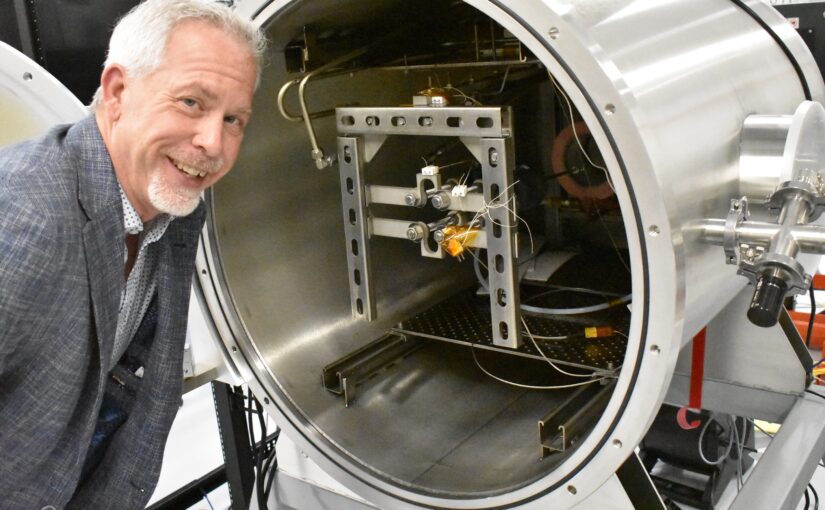
Uncommon Thinkers: How Portal’s Jeff Thornburg plans to harness the heat of the sun in the cold of space

Editor’s note: This series profiles six of the Seattle region’s “Uncommon Thinkers”: inventors, scientists, technologists and entrepreneurs transforming industries and driving positive change in the world. They will be recognized Dec. 11 at the GeekWire Gala. Uncommon Thinkers is presented in partnership with Greater Seattle Partners.

BOTHELL, Wash. — Before he became the CEO of Portal Space Systems, Jeff Thornburg worked for two of the world’s most innovative space-minded billionaires. Now he’s working on an idea those billionaires never thought to pursue: building a spacecraft powered by the heat of focused sunlight.

Thornburg and his teammates are aiming to make Bothell-based Portal the first commercial venture to capitalize on solar thermal propulsion, a technology studied decades ago by NASA and the U.S. Air Force. The concept involves sending a propellant through a heat exchanger, where the heat gathered up from sunlight causes it to expand and produce thrust, like steam whistling out of a teakettle.

The technology is more fuel-efficient than traditional chemical propulsion — and faster-acting than solar electric propulsion, which uses solar arrays to turn sunlight into electricity to power an ion drive. Solar thermal propulsion nicely fills a niche between those two methods to move a spacecraft between orbits. But neither NASA nor the Air Force followed up on the concept.“They didn’t abandon it for technical reasons,” Thornburg said. At the time, it just didn’t make economic or strategic sense to take the concept any further.

What’s changed?“Lower launch costs, coupled with additive manufacturing, are the major unlocks to bring the tech to life, and make it affordable and in line with commercial development,” Thornburg said.

Thornburg argues that it’s the right time for Portal’s spacecraft to fill a gap in America’s national security posture on the high frontier. “There was no imperative for rapid movement on orbit in the 1990s,” he said. “Only recently have the threats from our adversaries highlighted the weaknesses in current electric propulsion systems, in that they have so little thrust and can’t enable rapid mobility.”

Portal’s vision has attracted interest — and financial support — from investors and potential customers. Since its founding in 2021, the startup has raised more than $20 million in venture capital. In 2024, Portal won a commitment for $45 million in public-private funding from SpaceWERX, the innovation arm of the U.S. Space Force. And next year, Portal is due to demonstrate its hardware for the first time in orbit.

So, how did Thornburg hit upon the idea of turning a decades-old idea into reality? Thornburg, who’s now 52 years old, has focused on making things fly for most of his career. It all started when he was a college student in Missouri in the early 1990s, earning his aerospace engineering degree with an ROTC scholarship from the Air Force. He recalled a conversation he had with an instructor who was an old F-4 fighter pilot.“With my nearsightedness, I was out of the game from a pilot standpoint,” Thornburg said. “But he said, ‘Thornburg, if you can’t fly the planes, go be as close to them as you can.’”

Thornburg signed up for a program that fast-tracked him into an aircraft maintenance role. He traveled around the world with KC-135 cargo planes, supporting missions that included the NATO-led air campaign against Yugoslavia in 1999. During his time as a flight commander and aircraft maintenance officer at MacDill Air Force Base in Florida, “I had a couple of hundred enlisted people who worked hard to keep me out of trouble,” he said. The Air Force is where he earned his master’s degree in aerospace engineering. “My adviser had a friend that worked at the Air Force Research Lab,” Thornburg recalled. “He called him and said, ‘The Air Force is about to send this guy to do something with airplanes, but I’m pretty sure he’s going to be disappointed if he can’t come out and work on rocket engines.’”

Sure enough, Thornburg was soon working on rocket propulsion development, including a project to create what’s known as a full-flow staged combustion cycle engine. “We made what people thought was not possible possible with that program,” Thornburg said.

In 2004, Thornburg left the Air Force to work on rocket propulsion systems at Exquadrum, Aerojet and NASA. Then, in 2011, he took a phone call from SpaceX’s billionaire founder, Elon Musk. “We talked for about an hour, hour and a half on the phone — and he said, ‘I’ve got a project I want to talk to you about,’” Thornburg said. That project led to the development of SpaceX’s methane-fueled Raptor rocket engine, which leveraged the technology that Thornburg helped pioneer at the Air Force. “That was a wild ride, because that felt like about 15 or 20 years of experience in a five-year time period,” he recalled.

After five years at SpaceX, Thornburg needed to wind down. He decided to do some consulting at his home base in Huntsville, Alabama, also known as Rocket City. “About six months in, I’m like, I need a real job again,” he said. “And some friends of mine introduced me to, ultimately, Paul Allen. Paul called me and said, ‘Can you come out to my Seattle office?’” The Microsoft co-founder and software billionaire enlisted Thornburg to become the head of rocket propulsion development for Stratolaunch, Allen’s space venture. Thornburg led the effort to create a liquid rocket engine known as the PGA — which stood for “Paul G. Allen.” Unfortunately, Allen passed away in 2018, just one month after the engine was unveiled. Under new ownership, Stratolaunch pivoted to hypersonic testing, and the PGA project fell by the wayside. Once again, Thornburg and his family hunkered down in Huntsville.“I decided to start my first space company after Paul died,” Thornburg said. “I focused on hydrogen propulsion technology and solutions, kind of like what we were working on for Paul.”

That first company, Interstellar Technologies, started working on projects for NASA, Northrop Grumman and a couple of other customers. Then the pandemic hit. “The investors that were about to provide funding disappeared,” Thornburg said. “NASA went home, Northrop Grumman went home. And so I had to find my small team other jobs.” Just as Thornburg was about to resign himself to riding out the pandemic in Alabama, Amazon’s recruiters called. They asked him to move to Seattle to run engineering and manufacturing for Project Kuiper, the satellite internet project that’s now known as Amazon Leo. “That’s ultimately what got us moved to Seattle,” Thornburg said. His yearlong stint at Amazon was long enough to establish the process for building Project Kuiper’s two prototypes and the production-grade satellites that came after them. Then he took on engineering management roles at Agility Robotics and Commonwealth Fusion Systems.

That’s when Portal Space Systems took shape.

To be fair, the seeds for Portal were planted back in 2016, just weeks after Thornburg left SpaceX. “Lawrence Livermore Lab had called and said, ‘We’re doing a seminar on the future of propulsion. Would you like to come be a speaker?’” he recalled. “I said, ‘Yes, what do you want me to talk about?’ They said, ‘We want you to tell us what the future of propulsion looks like.’ Oh my gosh, no pressure on that!”

As he did the research for his talk, he came across the idea of putting a nuclear reactor on a spacecraft, and using the concentrated heat from that reactor to blast a propellant through a thruster. The concept, known as nuclear thermal propulsion, seemed like a stretch — but then Thornburg had an uncommon thought.“Can you concentrate solar energy to heat a thrust chamber and do the same thing?” Thornburg said. “You can. It’s not quite as effective as a nuclear reactor, for obvious reasons, but it’s all the same pieces. … Now I don’t have to wait on a low-cost, low-weight, space-rated nuclear reactor that doesn’t exist yet.”

Thornburg mulled over the idea for years. “I was thinking about Portal, and I was starting the beginnings of Portal in 2021, but I still had to pay the bills,” he said. For a couple of years, he worked during the day at Agility Robotics and Commonwealth Fusion — and spent nights and weekends laying the groundwork for the startup.“When Portal could really start to stand on its own, as we started to win over the Defense Department, that’s when I made the switch with all of my time focused on what was going on in Portal,” Thornburg said. In April 2024, the startup emerged from stealth and announced it had received more than $3 million in funding from the Defense Department and the Space Force. Portal’s flagship vehicle is called Supernova. It’s a rapid-transorbital, multi-mission vehicle that should be capable of moving itself and its payloads from one orbit to another — even from low Earth orbit to geostationary Earth orbit, more than 20,000 miles higher up. And it should be able to do that within hours or a day, rather than the weeks or months that are typically required. The spacecraft itself will be about the size of a restaurant refrigerator. To concentrate sunlight on its heat exchanger and thruster system, Supernova will use sheets of reflective material that can unfold to a width of roughly 55 feet. Ammonia will serve as the propellant. The 3D-printed heat exchanger thruster, dubbed Flare, was successfully tested earlier this year.

Next year’s orbital demonstration will involve putting an instrument package known as Mini-Nova, which is about the size of a tissue box, on a satellite platform that’s due for launch on a SpaceX rideshare mission. The demonstration is meant to validate Supernova’s system design. In late 2026, Portal plans to send up a free-flying spacecraft called Starburst, which will be equipped with thrusters powered by an electrothermal heating system. Starburst won’t be as powerful as Supernova, but it will provide Portal’s customers with an early option for rapid maneuverability in orbit. If next year’s test goes well, Starburst is expected to start taking on customer missions in 2027. 2027 is also the year when Supernova is scheduled to make its debut. All of the development work for Supernova and Starburst will be taking place at Portal’s 8,000-square-foot lab and 50,000-square-foot manufacturing facility in Bothell. Throughout Portal’s formative years, Thornburg has worked with fellow members of the “small team” he assembled at Interstellar Technologies. Both of Portal’s other co-founders — chief operating officer Ian Vorbach and engineering vice president Prashaanth Ravindran — crossed paths with Thornburg at Interstellar, and at Stratolaunch before that. Vorbach, whose background includes startup experience as well as engineering experience, said Portal’s business model has been fine-tuned to make sure it addresses the needs of its target market. He and Thornburg identified the U.S. military’s need for tactical responsiveness in space as the top priority.“What happens a lot in the space industry is that you have incredibly technical, talented people who have a technology that provides some very unique performance, and then they build it, and it turns out that performance isn’t needed,” Vorbach said. “There’s got to be a reason to bring that innovation to market.”

Vorbach is grateful for Thornburg’s leadership. “We work very long hours, but I think Jeff does a great job of making sure people know that they’re valued,” he said. “I appreciate that, and I think it’s why we, fortunately, are able to hire great talent from the places he’s come from, whether it’s SpaceX or Kuiper.” Ravindran, who worked at Jeff Bezos’ Blue Origin space venture before taking a founder’s role at Portal, agreed with that assessment. “It’s always amazing to have someone like Jeff out there, because he’s come up the engineering road to realize our pain points as well, and he doesn’t try to hold us to unfair standards.” Stan Shull, a space industry analyst at Bellevue, Wash.-based Alliance Velocity, gives Portal high marks. “In space terms, a highly maneuverable satellite is said to have high delta-V,” he told GeekWire in an email. “Portal, as a company, feels high delta-V too.”

Sam Ransbotham on Navigating the Nuances of AI: Beyond Hype and Mediocrity

Sam Ransbotham, a professor of business analytics at Boston College and host of the ‘Me, Myself and AI’ podcast, offers a pragmatic perspective on the evolving role of Artificial Intelligence. He observes a fascinating trend in his classroom: while some students are leveraging AI to achieve remarkable results, others fall into the trap of ‘phoning things into the machine,’ leading to a superficial engagement with the technology. Ransbotham emphasizes that the depth of understanding a user possesses directly correlates with the value derived from a tool. A cursory approach yields a rudimentary outcome, while deeper exploration unlocks greater potential.

Despite concerns about students prioritizing mediocrity—highlighting Boston College’s ‘Ever to Excel’ motto—Ransbotham maintains a positive outlook on AI’s potential. He argues that the technology’s true value often lies not in its output, but in the critical thinking it inspires. ‘The data gives better insights about what you’re doing, about the documents you have, and you can make a slightly better decision,’ he states, emphasizing the importance of questioning AI’s outputs, even when they seem ‘wrong’ or ‘ridiculous.’

Ransbotham draws parallels between the rise of Wikipedia and the current AI landscape. Just as Encyclopedia Britannica’s economic value diminished with the advent of Wikipedia, AI’s value extends beyond immediate, quantifiable results. He focuses on the ability of AI to provide new insights and encourage deeper analysis, framing the technology as a tool for ‘searching for the signal in the noise.’ Ultimately, Ransbotham advocates for a thoughtful and discerning approach to AI, recognizing its potential while guarding against the temptation of simply accepting superficial outcomes.

Rad Power Bikes Faces Another Roadblock as CPSC Issues Battery Warning

Embattled electric bike maker Rad Power Bikes is facing another challenge as the U.S. Consumer Product Safety Commission (CPSC) issued a warning to consumers Monday to stop using some of the Seattle-based company’s bikes because of danger posed by their lithium-ion batteries.

The product safety warning urges consumers to immediately remove and dispose of hazardous batteries that “can unexpectedly ignite and explode, posing a fire hazard to consumers, especially when the battery or the harness has been exposed to water and debris.”

The CPSC said Rad “has refused to agree to an acceptable recall” for the batteries, which are manufactured in China.

The batteries were sold as replacements and with a variety of Rad bikes via Rad’s website, Best Buy stores and independent bike shops. The battery model number (HL-RP-S1304 or RP-1304) is printed on a label on the back or rear of the battery and bike models included: RadWagon 4, RadCity HS 4, RadRover High Step 5, RadCity Step Thru 3, RadRover Step Thru 1, RadRunner 2, RadRunner 1, RadRunner Plus, and RadExpand 5. The report adds another significant obstacle to Rad’s continued operations.

Earlier this month, Rad revealed that it was struggling to survive due to financial difficulties, and the e-bike seller said that it was in danger of shutting down by early January.

On Monday, Rad disputed the CPSC’s findings. “Rad Power Bikes firmly stands behind our batteries and our reputation as leaders in the e-bike industry, and strongly disagrees with the CPSC’s characterization of certain Rad batteries as defective or unsafe,” the company said in a lengthy statement provided to GeekWire (in full below).

Rad said the significant cost of CPSC’s all-or-nothing recall demand would force Rad to shut down immediately with no way to support its riders or employees.

CPSC Warns Consumers to Immediately Stop Using Batteries for E-Bikes from Rad Power Bikes Due to Fire Hazard; Risk of Serious Injury or Death www.cpsc.gov/Warnings/202…

Rad said it offered “multiple good-faith solutions” to address CPSC’s concerns over at least 31 reports of fire, including what the agency said were 12 reports of property damage caused by Rad batteries, totaling approximately $734,500.

Rad said the incident rate associated with the batteries in the CPSC’s notice is a fraction of one percent.“While that number is low, we know even one incident is one too many, and we are heartbroken by any report involving our products,” the company’s statement read.

The company said its batteries were tested by independent third-party labs as part of its typical product testing and again during the CPSC investigation, “and confirmed compliance with the highest industry standards.”

Rad upgraded its bikes to what it calls the Rad Safe Shield battery in early 2024, and the company said it offered to upgrade consumers to those batteries at a substantial discount as part of one of its solutions during the CPSC investigation.

The company stressed in its statement that all lithium-ion batteries, not just in e-bikes, can pose a fire risk if improperly handled or exposed to significant water, and the company promotes proper care and maintenance in its user manuals and customer safety guides.

Rad Power Bikes, headquartered in Seattle’s Ballard neighborhood, launched as a direct-to-consumer brand in 2015. The company saw huge demand amid the pandemic as more people bought e-bikes. Its sales and workforce surged and it raised more than $300 million from investors in 2021. The company was valued at $1.65 billion that year, according to PitchBook, making it one of a handful of “unicorn” startups in the Seattle region at the time.

The company has attracted nearly 700,000 riders around the globe, but a series of missteps and macroeconomic challenges in recent years have led to more than seven rounds of layoffs and a remarkable downfall.

Three years ago, Rad issued a recall on its RadWagon 4 electric cargo bikes over an issue with tires and rim strips that created a fall and crash hazard.

In 2023, The New York Times reported on a rise in micro-mobility device fires or overheating incidents caused by poorly made batteries that the CPSC said was particularly acute in densely populated areas like New York City.

The CPSC urged consumers on Monday to immediately remove affected batteries and dispose of them following local hazardous waste procedures.

Rad Power Bikes statement regarding CPSC warning:

“Rad Power Bikes firmly stands behind our batteries and our reputation as leaders in the ebike industry, and strongly disagrees with the CPSC’s characterization of certain Rad batteries as defective or unsafe.

We have a long and well-documented track record of building safe, reliable ebikes equipped with batteries that meet or exceed rigorous international safety standards, including UL-2271 and UL-2849. The CPSC proposed requiring these UL standards in January 2025, but has yet to adopt them. Rad ebikes have met these standards for years.

Reputable, independent third-party labs tested Rad’s batteries, both as part of our typical product testing and again during the CPSC investigation, and confirmed compliance with the highest industry standards. Our understanding is that the CPSC does not dispute the conclusions of these tests. It is also our understanding that the battery itself was not independently examined per industry-accepted test standards.

Context Matters

The incident rate associated with the batteries in the CPSC’s notice is a fraction of one percent. While that number is low, we know even one incident is one too many, and we are heartbroken by any report involving our products.

It is also widely understood that all lithium-ion batteries—whether in ebikes, e-scooters, laptops, or power tools—can pose a fire risk if damaged, improperly charged, exposed to excess moisture, subjected to extreme temperatures or improper modifications to the electrical components, all of which Rad repeatedly advises against in user manuals and customer safety guides. Contrary to the CPSC’s statement, mere exposure to water and debris does not create a hazard; rather, significant water exposure, as warned against in our manuals, can pose a hazard.

These risks apply across industries and exist even in products that are fully UL compliant. Ebike batteries are significantly more powerful than household device batteries, which is why proper care and maintenance are so important and why Rad continues to invest in rider education and safety innovation.

Rad’s Cooperation with the CPSCRad hoped this process would be an opportunity to work with the agency and others in the industry to improve rider education and offer clearer, more consistent safety guidance on how to use and store ebikes and their batteries safely. Rad offered multiple good-faith solutions to address the agency’s concerns, including offering consumers an opportunity to upgrade to Safe Shield batteries (described below) at a substantial discount. CPSC rejected this opportunity. The significant cost of the all-or-nothing demand would force Rad to shut its doors immediately, leaving no way to support our riders or our employees.

A Commitment to Safety and Innovation

Rad has been a pioneer in promoting and advancing energy-efficient transportation, and our efforts to innovate and build safer, better batteries led to the development of the Rad Safe Shield battery. However, a product that incorporates new, safer, and better technology does not thereby mean that preceding products are not safe or defective. It simply means a better, safer technology was available to consumers. That kind of thinking discourages innovation and limits the accessibility that ebikes bring to millions of people. Without the adoption of clear, common-sense standards, no electric bike manufacturer can operate with confidence. Previously:

Ключові рухи: Вашингтон призначає керівника з економічного розвитку; Надела перепрофілює нового радника з питань ШІ; Зміни в керівництві IPD

Ключові рухи: Вашингтон призначає керівника з економічного розвитку; Надела перепрофілює нового радника з питань ШІ; Зміни в керівництві IPD

Andrea Chartock стала керівником Офісу економічного розвитку та конкурентоспроможності Вашингтона, підрозділу Державного департаменту торгівлі штату. Chartock більше ніж 21 рік працювала в міжнародній компанії з розвитку DAI, працюючи над ініціативами USAID в країнах, включаючи Ліберію та Молдову. Її останні зусилля були зосереджені на економічному зростанні в Україні до того, як USAID було дефінансовано цього року.

Директор Державного департаменту торгівлі Джо Nguyễn сказав, що Chartock «має досвід і відданість, необхідні для піднесення нашого існуючого бізнес-спілкування та сприяння зростанню новими, інноваційними способами». У цьому році департамент зменшив масштаб важливої економічної програми в умовах бюджетного тиску штату. Департамент зараз управляє понад 8 мільярдами доларів США в 485 програмах, Nguyễn сказав у квітні.

Julie Brill, колишній головний офіцер з питань приватності Microsoft, приєдналася до ради директорів компанії Ethyca з програмним забезпеченням. «Підхід Ethyca ставить приватність, безпеку та політику в центр інфраструктури бізнес-даних. Я радий допомогти керувати компанією, коли вона співпрацює з глобальними організаціями для масштабування ШІ відповідальним чином», – сказала Brill у заяві.

Brill покинула Microsoft у липні після понад вісім років роботи. Її посада включала посаду корпоративного віце-президента з питань приватності, безпеки та регуляторних питань. Brill також виконує роль експерта-резидента при Гарвардському університеті. Раніше вона поділилася планами відкрити консалтингову фірму восени.

CEO Microsoft Satya Nadella призначив роль консультанта з питань ШІ економіки Rolf Harms, корпоративного віце-президента великого технологічного гіганта, для співпраці з топ-лідерами компанії. Business Insider отримав червене звіт November від Nadella, оголошуючи розширену роль Harms. Harms працює в Microsoft майже два десятиліття та написав фундаментний whitepaper у 2010 році, який стосувався економіки хмарних обчислень.

«Нам потрібно швидко переосмислити нову економіку ШІ в усій компанії — так само, як ми це зробили з хмарою», — написав Nadella, за BI. «Цей платіжний зсув — це побудова нового ШІ-фабрики та сімейства агентів, які стимулюють поширення та використання на повній платформі».

Seattle Reign FC та Seattle Sounders FC оголосили про те, що Sean Coury став головним фінансовим директором. Coury приєднався до футбольних клубів з Bezos Academy, де він обіймав посаду CFO некоммерчної організації, заснованої засновником Amazon Jeff Bezos. Раніше Coury працював у фінансових ролях у Bill & Melinda Gates Foundation та Apptio, де компанія Bellevue, Wash., пройшла публічну подачу заявок. The Reign та Sounders минулого місяця найняли Ro Vega на посаду головного маркетолога.

Francois Ajenstat покинув свою посаду головного продуктового директора в компанії Amplitude. Ajenstat раніше був CPO в Seattle’s Tableau Software, де він працював 13 років, слідом за невеликим періодом роботи в Salesforce, який завершився у 2023 році. Раніше Ajenstat працював в Microsoft протягом десятиліття, займаючи посади технічного містика, менеджера продукту та старшого директора з питань екологічної стійкості.

The University of Washington’s Institute for Protein Design (IPD) має кілька змін у керівництві. Професор біохімії UW Neil King тепер Deputy Director IPD, а Lance Stewart, колишній тимчасовий виконавчий директор, виходить з організації. King раніше був асоційованим професором в IPD, а Лауреат Нобелівський David Baker залишається директором. «Коли я приєднався до IPD у 2013 році, було очевидно, що допомога у побудові IPD буде єдиною в своєму роді можливостю внести вклад і спостерігати з перших рук за розвитком нової галузі, заснованої на обчислювально розроблених білках», — сказав Stewart на LinkedIn. IPD також найняли трьох додаткових співробітників.

Alex Pettit повернувся в Орегон, щоб обімати посаду директора з цифрової трансформації проєктів штату. Pettit раніше обіймав керівні ролі в технологіях для штатів Орегон, Техасу та Оклахоми, і останнім часом був головним технологічним офіцером Колорадо майже шість років. «Це наступний етап дозволяє мені принести загартований досвід з місця та застосувати його до знайомих місць. Я з гордістю знову сприятиму технологічному майбутньому штату Орегон — допомагати модернізувати застарілі платформи, еволюціонувати нашу корпоративну архітектуру та готуватися до вимог майбутнього», — написав він на LinkedIn.

Brian Bishop є CEO Portland, Ore.-based Skip Technology, стартапу, який будує довготривалі, мережеві акумуляторні батареї. Bishop бере на себе посаду, яку раніше обіймав Brennan Gantner, який спільно заснував компанію з бромування, сім років тому. Bishop має понад 30 років досвіду інженерії, виробництва та управління в різноманітних електронних підприємствах. Він раніше працював у Salt Creek Capital, який придбаває та рекапіталізує невеликі компанії.

Kelly Goetsch отримала нову посаду на e-commerce logistics startup Pipe17, перейшовши з посади головного операційного директора на посаду президента. Seattle startup оголосила про раунд Series A на суму 17,5 мільйонів доларів цього року. Goetsch також допомагала створити перший відкритий стандарт, що єдинить, як обмінюються інформацією системи електронної комерції, включаючи AI-powered selling channels та payments, logistics та fulfillment. Спроба була здійснена некомерчною організацією Commerce Operations Foundation, яка випустила стандарт на тиждень.

Tom Mara, executive director of SIFF, покинув свою посаду некоммерчної організації після того, як було вирішено не продовжувати контракт, повідомив Seattle Times. Mara раніше керував популярним радіоефірним шоу KEXP, потім приєднався до SIFF у 2022 році. Наступного року Mara оголосив про придбання організації історичного Cinerama, кінотеатру, який раніше належав співзасновнику Microsoft Paul Allen, який припинив роботу під час пандемії. Придбання було відзначено багатьма, але у будівлі були фінансові труднощі.

Washington’s Quantum Ambitions: A Strategic Push for Growth

Washington faces a quantum paradox: despite possessing key ingredients – including tech giants like Microsoft and Amazon, the hardware leader IonQ, and world-class research at UW and PNNL – it risks falling behind states actively advancing quantum technology. Experts emphasize the need for a faster strategy and targeted investment to bolster the region’s quantum ecosystem.

Panelists at a recent Tech Alliance event in Seattle highlighted the urgency. Representative Stephanie Barnard advocated for a $100 million injection, stating, “It takes courage. It takes dynamic leadership. It takes a political will to recognize the needs of this state.” However, budgetary constraints pose a significant challenge, with Beau Perschbacher, policy advisor to Governor Bob Ferguson, noting that substantial new investments are currently “very hard” to secure.

States like Illinois – with Governor J.B. Pritzker earmarking $500 million – and Colorado are aggressively pursuing quantum strategy and workforce investment. Suggestions include shifting priorities away from established industry subsidies and exploring options such as a $300 million investment in quantum research over 10 years.

University of Washington professor Charles Marcus emphasized the importance of a focused approach, stating, “Quantum researchers will ‘go to where the funding is and where the environment favors success.’” He called for industry support of a dedicated master’s program to generate a skilled workforce. Marcus described the quantum race as one “in which, if you’re standing still, you’re going backwards.”

Laura Ruderman, CEO of Tech Alliance, suggested scaling existing efforts rather than initiating new initiatives. She referenced the Northwest Quantum Nexus (NQN), founded in 2019 by UW, Microsoft, and PNNL. IonQ CMO Margaret Arakawa urged leaders to publicly prioritize quantum and engage private funding partners, pointing to states with visible leadership in the field.

Out of Office: Microsoft Research’s Peter Lee is a Car Geek Revved Up by Converting Classics to Electric

Out of Office is a new GeekWire series spotlighting the passions and hobbies that members of the Seattle-area tech community pursue outside of work. Peter Lee, head of Microsoft Research, is a prime example, passionately converting classic cars to electric vehicles.

When Lee first started his research project to convert his 1955 Porsche 550 Spyder to electric, he utilized the AI model Davinci-003 (OpenAI’s early Chat GPT-4) for engineering assistance. Initially, the AI questioned the decision, prompting Lee to respond, “Why on earth would you want to ruin a beautiful classic car like that?”

Now, in the midst of converting a 1968 Ford Mustang GT Fastback, Lee regularly encounters fellow car enthusiasts expressing concern about his hobby. “Half the people I’ve told about this project think it’s the coolest thing, and the other half think it’s totally evil,” he noted. “One guy actually told me I’m never going to heaven.”

Lee, who joined Microsoft in 2010 and previously spent 22 years at Carnegie Mellon University, was recognized as one of Time magazine’s 100 most influential people in health and life sciences in 2024. His lifelong love for cars began with karting and Formula Ford, and he even held a license as an auto body technician.

Frustrated with fuel system issues in his Porsche in 2020, Lee connected with Marc Davis, founder of Moment Motor Co. in Austin, Texas, a company specializing in transforming vintage cars into modern electric vehicles. Moment’s dedication is to “preserve the art and beauty” of classic cars like those owned by Lee.

Some classic car enthusiasts criticize EV conversions, arguing they disrupt the original design intent and involve excessive costs. Davis states that Moment’s work frequently generates “vomit emojis” from purists on the company’s social media.

“I personally believe what we’re doing is preservation,” Lee explained, highlighting projects that breathe new life into cherished vehicles. The cost of a conversion can range from $50,000 to $150,000, depending on the car’s condition, size, and performance requirements.

Lee is drawn to the benefits of electric vehicles – eliminating gas and oil concerns, modern components, and powerful torque. In the Pacific Northwest, his Porsche is garaged during the winter at a 50% charge. He anticipates powering up on the first pleasant spring day, stating, “I’ll just check the air in the tires, turn it on, and it’ll just go. And it’ll go fast. It’s really a wonderful, wonderful thing,” adding that the Porsche, a replica of the car in which Hollywood icon James Dean died, can reach speeds that are “a little scary.”

Lee is actively involved in the Mustang’s transformation, considering details like the shift knob and the rear axle. “I put thought into this, especially when I was driving the car to get to know it,” he said. “I ended up thinking that the car wouldn’t be a Mustang anymore if we got rid of the live rear axle, and it turned out that Marc’s design choice was exactly the same.” The finished Mustang will be a unique build, garnering attention at car shows.

Lee is considering a third vehicle for conversion, joking about his wife’s potential disapproval. The most rewarding aspect of this pursuit is the technical and design challenges. In the case of the Porsche conversion, he grapples with preserving the car’s identity as a Mustang. “The thing I’ve always loved about cars, and why I love to work on cars, is you actually finish something,” he said. “That never happens in software. Software’s never done. You might ship it, but you’re still working on it forever.”

Lee believes there’s significant business potential in converting classic cars to EVs and sees opportunities to collaborate with companies doing this work. He notes that the combination of classic aesthetics with modern EV technology is a growing trend.

Lee’s experience translates to his work at Microsoft Research. He sees parallels between car technology and auto racing and believes advancements in both fields can inform the design of action models—AI systems that predict and determine the best course of action for an agent. He believes that developments in car software could influence the architecture of action models and training paradigms, with implications for software development. “It wouldn’t surprise me if five years from now the ’68 Mustang conversion has more intelligence, more self-drive, more action model, more robotic capabilities,” Lee said. “I think you’ll see those things pop up even in your plain old Windows desktop over time.”

Новий президент університету Вашингтон Роберт Джонс прагне розвіяти страхи щодо «кінцевої апокаліпсису робот» та підготувати кожного випускника до майбутнього з використанням ШІ

Новий президент університету Вашингтон Роберт Джонс прагне розширити доступ до комп’ютерних наук для бакалаврів та побудувати нові публічно-приватні партнерства для вирішення суспільних глобальних проблем — і має конкретні ідеї щодо того, як це зробити. Більше ніж через 100 днів перебування на посаді 34-го президента університету Вашингтон, Джонс також працює над розвіюванням двох панівних міфів: що надзвичайно складно вступити до Школи комп’ютерних наук та інженерії Пол Г. Ейлен з університету Вашингтон, та що ШІ забирає у всіх робочі місця.

Цього року Школа Пол Г. Ейлен — один із провідних технологічних програм країни — прийняла 37% від усіх безпосередніх абітурієнтів з вищих шкіл штату Вашингтон, хоча внески з інших штатів становлять лише 4%. «Ми насправді приймаємо на навчання набагато більше студентів, ніж загально вважають», – сказав Джонс на тижневому інтерв’ю з GeekWire.

Щодо апокаліпсису робочого місця, спричиненого ШІ? «Це перебільшений страх», – сказав Джонс. ШІ є «критично важливим інструментом, який потрібно мати у своєму «інструментальному скриньці», щоб бути більш ефективним у майбутньому».

Використовуючи свій досвід керівництва Університетом Іллінойсу в Урбана-Шампейні, Джонс хоче надати більший «шматок» з 45 000 бакалаврів університету Вашингтон доступ до курсів комп’ютерних наук — навіть якщо вони є частиною інших освітніх програм. Ідея заснована на революційній ініціативі «CS + X», яку він допоміг розширити під час свого попереднього президентства в Іллінойсі. Програма створила технологічно орієнтовані дослідження в 17 освітніх програмах, включаючи рекламу, астрономію, економіку, музику, філософію та фізику.

УІллінойсі ініціатива CS + X стартувала понад десять років тому через те, що агротехнології є, і залишаються, одним з найшвидше зростаючих секторів штату. Сам Джонс розпочав свою кар’єру як професор фізіології рослин і став міжнародним авторитетом у цій галузі.

«ШІ — це просто чудовий інструмент, і ми тут виконуємо роботу, щоб переконатися, що наші студенти отримують якомога більш повну освіту», – сказав Джонс. Розширення знань випускників з комп’ютерних наук та штучного інтелекту, крім їхнього основного напрямку, робить їх «набагато більш затребуваними на ринку праці».

10 мільйонів доларів, оголошені в останнім тижні від Microsoft-піонера Чарльза Симоні та його дружини, Лізи Симоні, допоможуть інтегрувати ШІ в освіту та дослідження в усьому університеті через новостворену ініціативу AI@UW. AI@UW, яка включає в себе нову провінціала з штучного інтелекту, допоможе Університету підтримувати «стратегічну перевагу» як лідера в галузі ШІ, як заявив Джонс. Це також приклад того, як можна розвивати публічно-приватні партнерства.

Джонс уявляє собі розширення того, що він називає «радикальними партнерствами» — побудову різноманітних коаліцій у географічному плані, між установами та секторами для вирішення проблем «які занадто великі для вирішення однією організацією»,

Ці співпраця забезпечують експертизу та фінансування. Університет стикається з важким фінансовим становищем, оскільки доходи штату Вашингтон продовжують слабшати, що призводить до вичерпання вже напруженого бюджету. До цього додаються проблеми з фінансуванням федеральних дослідницьких програм, на які сильно покладається Університет. Джонс посилається на довготривалу програму WWAMI університету Вашингтон, яка обслуговує медичних студентів із штатів Вашингтон, Вайомінг, Аляска, Монтана та Айдахо, які отримують ступені в Університеті Вашингтон і повертаються до своїх громад, щоб практикувати медицину, як наприклад ідеальний приклад радикального партнерства.

«Я зробив приблизно три-чотири таких партнерства за останні 10 років, і вони просто чудові способи об’єднати людей та задуматися про те, як проводити дослідження інакше, більш спільно, більш впливовим, ніж ми ніколи раніше не думали», – сказав Джонс. Стратегія особливо підходить для ШІ, квантових обчислень або інших масштабних технологічних проблем, він зазначив. Джонс брав участь у партнерствах з Університетом Чикаго, щоб зміцнити дослідження в галузі квантової науки, і в біологічному дослідженні з Chan Zuckerberg Biohub Chicago. У майбутніх співпрацях у своїй новій ролі Джонс з нетерпінням чекає на тісну співпрацю «безперешкодно» з регіональним сектором технологій, використовуючи той факт, що UW створила екосистему, яка включає таких гігантів, як Amazon і Microsoft, а також сотні менших компаній. Більше ніж 110 «спадкових» спайнів від UW вже працюють у штаті, згідно з програмою CoMotion університету Вашингтон, яка підтримує підприємництво.

«Те, що нам потрібно більше робити – це працювати разом, щоб фінансувати та створювати наступну велику ідею, яка буде трансформаційною, не лише для штату Вашингтон, але й для нації та світу», – сказав Джонс.

Amazon Розширює Мережу Повернення Пакунків Партнерством з Goodwill у Сіетлі

Amazon розгортає пункти повернення пакунків у магазинах Goodwill по всій області Сіетла, надаючи клієнтам новий спосіб здачі повернених товарів.

Це останній крок у зусиллях Amazon щодо розширення мережі повернення за межі власних магазинів «Whole Foods», «Amazon Fresh» та «Amazon Go».

Пункти Amazon будуть доступні у всіх магазинах Evergreen Goodwill of Northwest Washington – 21 локації в п’яти округах. Деякі вже працюють, а решта стане операційною до кінця місяця.

Я помітив можливість повернення товару в Goodwill як опцію повернення трохи цього тижня, намагаючись повернути товар на Amazon.com, і протестував пункт повернення всередині магазину Goodwill у Редмонді, штат Вашингтон.

На вході є вивіска, яка повідомляє клієнтам про нову опцію здачі поверненого товару, але наступний крок не був очевидним відразу. Після того, як я направився до касирів, я помітив пункт повернення поруч із касовими апаратами та навпроти викладки різдвяних товарів на продаж.

Досвід схожий на використання самообслуговувальних кіосків Amazon: сканування QR-коду, відправленого Amazon, запакування товару у надану пластикову плівку (відправляти коробку не потрібно), прикріплення наліпки, відкриття люка та скидання товару в бінокль. Це не потребує будь-якої плати від клієнта. Унікальна особливість: на екрані з’явився купон на 20% знижки після завершення повернення. Кіоск також задавав два питання: «Ви зазвичай буваєте в Goodwill?» та «Ви робите покупку сьогодні?» з кількома варіантами витрат.

З моїм купоном я блукав і натрапив на кілька футболок Microsoft – не так вже й дивно, враховуючи близькість магазину до кампусу компанії в Редмонді. Amazon встановив подібні партнерства з іншими третироператорами, наприклад, з Kohl’s та Staples, надаючи клієнтам більше місць для повернення товарів без необхідності пакування їх. Ця стратегія допомагає Amazon знизити витрати на обробку повернень та розширити фізичну присутність без придбання нової нерухомості.

«Ми продовжуємо покращувати безшовний досвід повернення та пропонуємо більше зручних точок здачі повернених товарів», – заявив Amazon у заяві. «Коли клієнти відвідують наші магазини для повернення пакунків, вони також мають можливість пожертвувати або придбати», – сказала Alyssa Grigg, старший директор з маркетингу та комунікацій Evergreen Goodwill. Вона додала, що цей партнерський проєкт особливо корисний для клієнтів у більш сільських районах, де менше можливостей для повернення товарів.

Amazon заявляє, що чотири з п’яти клієнтів у США мають точку здачі повернених товарів на відстані п’яти миль від їхнього дому. Компанія пропонує безкоштовні повернення для більшості товарів, доставлених у США. Онлайн-ритейлери продовжують боротися з зростаючими витратами на повернення. Середній рівень повернення для онлайн-покупок становив 16,9% у 2024 році, за даними звіту National Retail Federation та Happy Returns. Загальні обсяги повернень у 2024 році оцінювалися в 890 мільярдів доларів.

PNNL Layoffs Impact 68 Employees in Pacific Northwest

Battelle Memorial Institute, the government contractor responsible for Pacific Northwest National Laboratory (PNNL), is announcing layoffs affecting 68 employees across various sites in the Pacific Northwest, primarily in Washington state. The news was revealed through a Worker Adjustment and Retraining Notification (WARN) filing submitted to the state’s Employment Security Department. The affected positions are scheduled to conclude between November 18th and December 1st.

In the WARN letter, Battelle cited ‘unforeseen business circumstances’ as the reason for not providing 60-day notices to impacted workers. The company explained that funding uncertainties and evolving federal mission priorities led to this decision. Battelle attempted to mitigate the situation by reassigning work, reducing employee hours, and utilizing furlough status, hoping for additional funding to materialize. However, a workforce restructuring and subsequent staff reduction were deemed necessary across both research and operational areas.

Of the 68 employees impacted, 42 are based at PNNL’s main campus in Richland, Washington; three are located in Seattle; three in Oregon; and 20 are working remotely. PNNL, a 60-year-old institution managed by the U.S. Department of Energy, employed approximately 6,400 individuals last year. The laboratories conduct fundamental research in fields such as energy, chemistry, data analytics, and other scientific and technological disciplines.

These layoffs follow a previous reduction in staff announced this summer, with Battelle citing budget uncertainty. In September, the company also reduced medical benefits for retirees, as reported by the Tri-City Herald. U.S. Sen. Patty Murray, D-Wash., previously reported in February that a small number of PNNL employees were affected during the Trump administration’s initial government workforce reductions. These cuts were linked to initiatives like the Department of Government Efficiency (DOGE), previously led by Elon Musk, and executive orders related to climate change and diversity, equity, and inclusion efforts.

Affected employees held roles including national security specialist, software, mechanical, nuclear or systems engineer, cybersecurity researcher, data scientist, project manager, administrative coordinator, and other similar positions.

Aquagga: Innovating Solutions to Tackle ‘Forever Chemicals’

Editor’s note: This series profiles six of the Seattle region’s “Uncommon Thinkers”: inventors, scientists, technologists and entrepreneurs transforming industries and driving positive change in the world. They will be recognized Dec. 11 at the GeekWire Gala. Uncommon Thinkers is presented in partnership with Greater Seattle Partners.

After earning his bachelor’s degree in mechanical engineering, Brian Pinkard spent six months “flipping rocks,” as he describes it, in Colorado’s Rocky Mountains. The rock-flipping was purposeful work: Pinkard was clearing obstructions and building trails for AmeriCorps, spending every night in a tent. “I loved it. It was great. And the reason I did that is because I wanted to do something that mattered, that made a difference in the world,” he said. When the program ended, he was inspired to direct his impact to a larger environmental challenge.

His passion to do good, paired with an engineer’s drive for problem solving, led him to a doctoral degree from the University of Washington and then to launching Aquagga, a startup that’s destroying PFAS — a toxic class of pollutants known as “forever chemicals.” “Brian has been very laser focused on his mission,” said Igor Novosselov, Pinkard’s PhD advisor and research professor at the UW’s Department of Mechanical Engineering. “He’s not a typical scientist who would just go and write a bunch of papers. He’s going after impact where it matters.”

But a few steps before PFAS, Pinkard was focused on nerve gas in the Middle East. When Pinkard joined Novosselov’s lab, it had U.S. Department of Defense funding to develop an in-the-field, mobile strategy for treating barrels of abandoned chemical weapons in the Syrian desert. The previous solution was to truck the barrels to the Mediterranean Sea, load them on a boat and incinerate the material. “If you’re the guy who’s got to transport a nerve agent,” Pinkard noted, “it’s not a very good job.”

Within five years, the lab came up with a workable solution, but the need was no longer urgent and DoD shelved its application of the technology, though Novosselov continued to work on it.

Pinkard appreciated the tremendous power of the strategy for treating dangerous materials and wondered if there was another use case. Then as he was preparing to finish his PhD in June 2020, the COVID pandemic hit, derailing his plans to apply for a university postdoctoral fellowship as no one was hiring. So he made a pivot to entrepreneurship — a role he had never considered. Pinkard teamed up with engineer and tech innovator Nigel Sharp to explore the potential for using the tech, called supercritical water oxidation, to treat sewage sludge from wastewater treatment plants, but they realized the market wasn’t viable.

There was, however, buzz about PFAS. “Everybody was talking about PFAS,” he said, and if anyone could figure out how to destroy the chemicals, it would be a breakthrough. That realization became his lightbulb moment. PFAS is a family of chemicals that for decades have been added to firefighting foams, food packaging, carpets and fabrics, water-repellent clothing and non-stick pans. The resilient chemicals are great at deflecting water, stains and grease — but they escape from products and now contaminate drinking water across the nation and are even in mothers’ breast milk. PFAS are still in use, while researchers and regulators are increasingly concerned by their serious health impacts.

Pinkard and Sharp launched Aquagga in 2019 in Tacoma, Wash., and were soon joined by co-founder Chris Woodruff. The team kept the idea of modular treatment units but shifted to a related but different chemistry (hydrothermal alkaline treatment) for destroying PFAS, securing a patent for the approach from the Colorado School of Mines. “Brian has been a great partner from the beginning,” said Timothy Strathmann, a Colorado School of Mines professor. “Unlike many entrepreneurs I’ve interacted with, he is also deeply interested in understanding the limitations and technical challenges associated with the technology. He’s keenly aware that the long-term success of Aquagga will only be achieved by addressing the critical barriers to deployment.”

Aquagga’s devices annihilates PFAS under super hot, high pressure conditions made caustic and corrosive through the addition of lye. The company has done nine field demonstrations of its technology, including a project at an airport in Alaska, a DoD-funded project in North Carolina involving firefighting foams, and a wastewater demo with the City of Tacoma. It’s now close to signing its first long-term commercial deployment, Pinkard said, “which will be a huge milestone for us.”

“It’s really cool to see how much PFAS we’ve destroyed … even in our short journey,” Pinkard said. “And to think about where it could go, what it could enable at scale. So [I’m] very optimistic about Aquagga’s future. I’m very optimistic about the impact we could create, the lives we could save.”